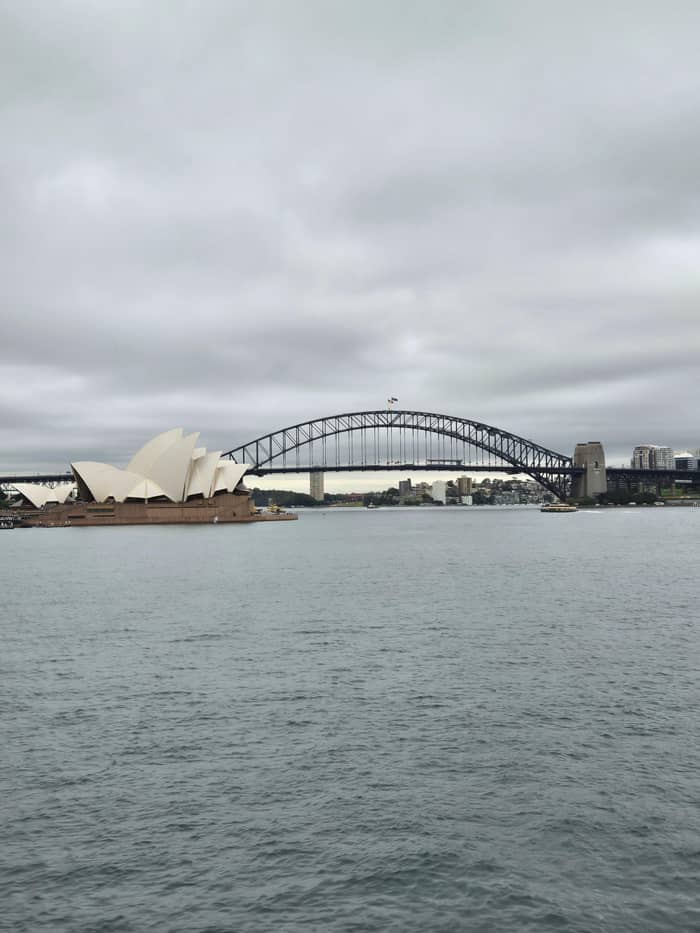
For your first day
The sightseeing bus
Route, commentary, open top
- From$53
- Routes2 routes, 23 stops
- LuggageNo suitcases
Guides
Language
Currency
View availabilityfrom $53 · cancel for freeCost for your party
The short version
To get around Sydney, tap a bank card or Opal card on trains, buses, ferries and light rail with daily fare caps, and keep the sightseeing bus for a day with commentary.
Transport essentials
Weigh up 3 options
Pick how many are coming and compare starting prices with a capped Opal day.
≈
View≈
View≈
ViewStarting prices from GetYourGuide, converted at the ECB reference rate. You will see the exact price when booking.
Sydney has a capped, tap-and-go network of trains, buses, ferries and light rail. Here is what it costs, how it works with a bank card, and when the sightseeing bus still wins.
Editorial team, sydneyhoponhopoff.com · Updated November 8, 2026 · Quick read: 7 min
Summary view
Sydney gives visitors a real choice in how they move between its sights. The sightseeing bus sells you a route: open-top buses on 2 routes with 23 stops, recorded commentary in 8 languages, and 24 or 48 hours to ride. Public transport sells you the whole city: metro, train, bus, ferry and light rail, all on a single tap-and-go system with a daily ceiling on what you pay.3
The public system is easy for visitors. You can tap on and off with the same American Express, Mastercard or Visa card or phone, and you pay the same Opal fare and get the same benefits as with an Opal card.1,2 If you prefer a card, Opal cards are sold at train stations, at the domestic and international airport, and at many shops across the city.6 A bank card is charged the adult fare.7
So the question is not which gets you there, since both do, but what you want from the ride. The bus is a tour that happens to move you; public transport is transport that happens to pass the views. Most visitors end up using both, and this page shows where the line falls. It covers the network, the fare table, the caps that make a busy day cheap, and the cases where paying for a sightseeing seat is still the better deal. Fares here are in Australian dollars, as Transport for NSW publishes them.
The fare table
| Mode | Distance | Peak | Off-peak |
|---|---|---|---|
| Bus | Up to 3 km | AUD 3.304 | AUD 2.314 |
| Bus | 3 to 8 km | AUD 4.494 | AUD 3.144 |
| Light rail | Up to 3 km | AUD 3.3020 | AUD 2.3120 |
| Train or metro | Up to 10 km | AUD 4.3318 | AUD 3.0318 |
| Ferry | Up to 9 km | AUD 7.355 | Same fare |
| Ferry | Over 9 km | AUD 9.205 | Same fare |
Transport for NSW adult fares; daily caps of AUD 19.30 Monday to Thursday and AUD 9.65 Friday to Sunday apply on top.3
Does Sydney have good public transport? For a visitor, the network covers the places you are likely to go. Central Station at Railway Square is the main terminus, and trains run north across the harbour, east to Bondi Junction and south to the airport.12 The airport itself is about nine kilometres south of the city centre.13
Light rail fills the gaps the trains miss. The L2 Randwick line and the L3 Kingsford line both start at Circular Quay and run south through the city.8 The metro line between Chatswood and Sydenham has stations at Barangaroo, Martin Place, Gadigal, Waterloo and Crows Nest, which makes Barangaroo a short hop from the centre.14
The ferries are the network's showpiece. From Circular Quay, the F2 runs to Taronga Zoo, another harbour route serves Rose Bay and Watsons Bay, and the F1 or the Manly Fast Ferry crosses to Manly.11 Late at night, NightRide buses replace most train routes between midnight and 4.30am.15 Circular Quay ties it together as the main ferry terminal and a hub for light rail, trains and buses.16,17
What Sydney buses cost depends on how far you ride and when. Every mode is split into distance bands.22 On buses, an adult trip of up to 3 km costs AUD 3.30 at peak and AUD 2.31 off-peak; 3 to 8 km costs AUD 4.49 or AUD 3.14; and longer trips AUD 5.77 or AUD 4.03.4 Light rail uses the same bands and prices for its shorter distances.20
Off-peak matters. Metro, train, bus and light rail fares are 30% cheaper on Fridays, weekends, public holidays and outside peak times.19 Trains and the metro start at AUD 4.33 at peak and AUD 3.03 off-peak for up to 10 km.18 Ferries do not get the off-peak cut on the fare table: AUD 7.35 up to 9 km and AUD 9.20 beyond.5
Some rules catch visitors out. Opal single tickets, the paper backup, are sold for metro, train, ferry and light rail but not as a bus option, so on a bus you need a card or phone.23 And if you forget to tap off, you are charged the maximum possible fare for that trip.24 A card or contactless tap is always cheaper than a single ticket anyway.21
Pick your way
Say what today looks like and see the way to get around that fits it.
If It is my first day in Sydney
The sightseeing bus
Both loops with commentary in 8 languages.
If I am exploring on a weekend
Tap and go
From Friday to Sunday an adult day costs AUD 9.65 at most.3
If I want the harbour beaches
Public ferries
From the quay the F1 goes to Manly, and another ferry serves Watsons Bay.11
If I am carrying luggage today
Train or taxi
The sightseeing bus allows no suitcases or carry-on bags.
If I am out late
NightRide buses
They replace most train routes from midnight to 4.30am.15
Ways to move
For your first day
Route, commentary, open top
For every day
Bank card or Opal card
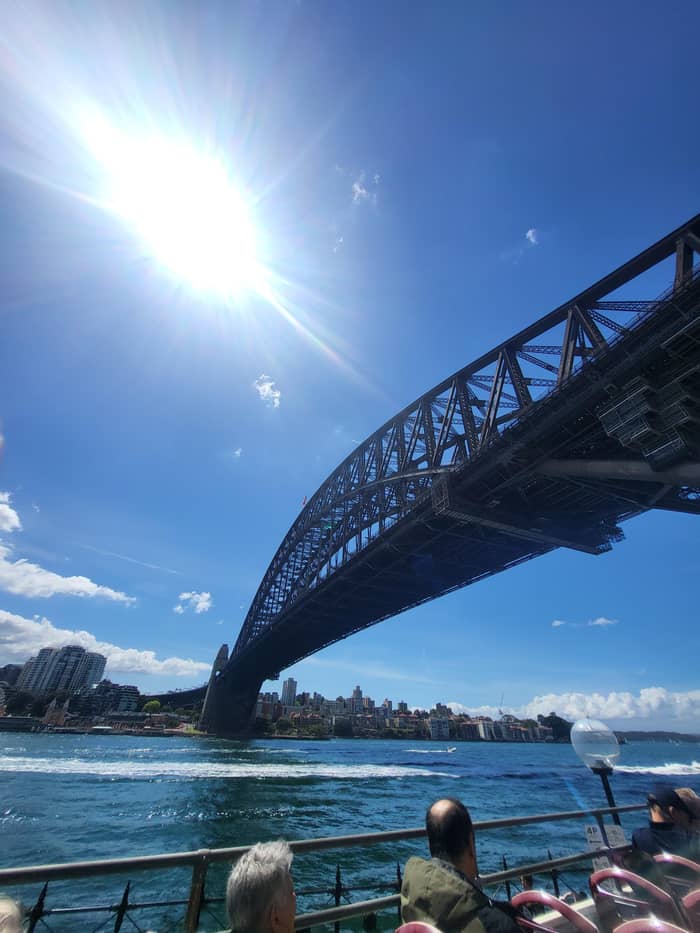
For the water
Hop-on hop-off cruise
The caps are what make public transport cheap for sightseers. Fares for an adult freeze at AUD 19.30 on any Monday to Thursday, at a holiday-and-weekend rate of AUD 9.65 from Friday, and at AUD 50 across the week.3 The day for those caps runs from 4am to 3.59am the next morning, which covers a late dinner across the harbour.61
Changing between modes earns a discount. Each transfer between modes in one journey takes AUD 2 off an adult fare, or AUD 1 for child, concession and senior fares.58 Several trips with transfers within 60 minutes count as one journey.62 The Manly ferry is more generous, allowing 130 minutes, which suits a slow lunch by the beach before the ride back.63
Paper single tickets do not share these benefits. They work only on the day you buy them, up to 4am the following morning, they are single use, and you cannot break a journey or buy a return.64,65 For a visitor, the simplest plan is to tap the same bank card every time, so every trip counts toward the same cap.1 Keep it apart from other cards in your wallet, so the reader always charges the same one. Pick the card with the lowest foreign transaction fees, as you may tap it many times in a busy day of sightseeing.
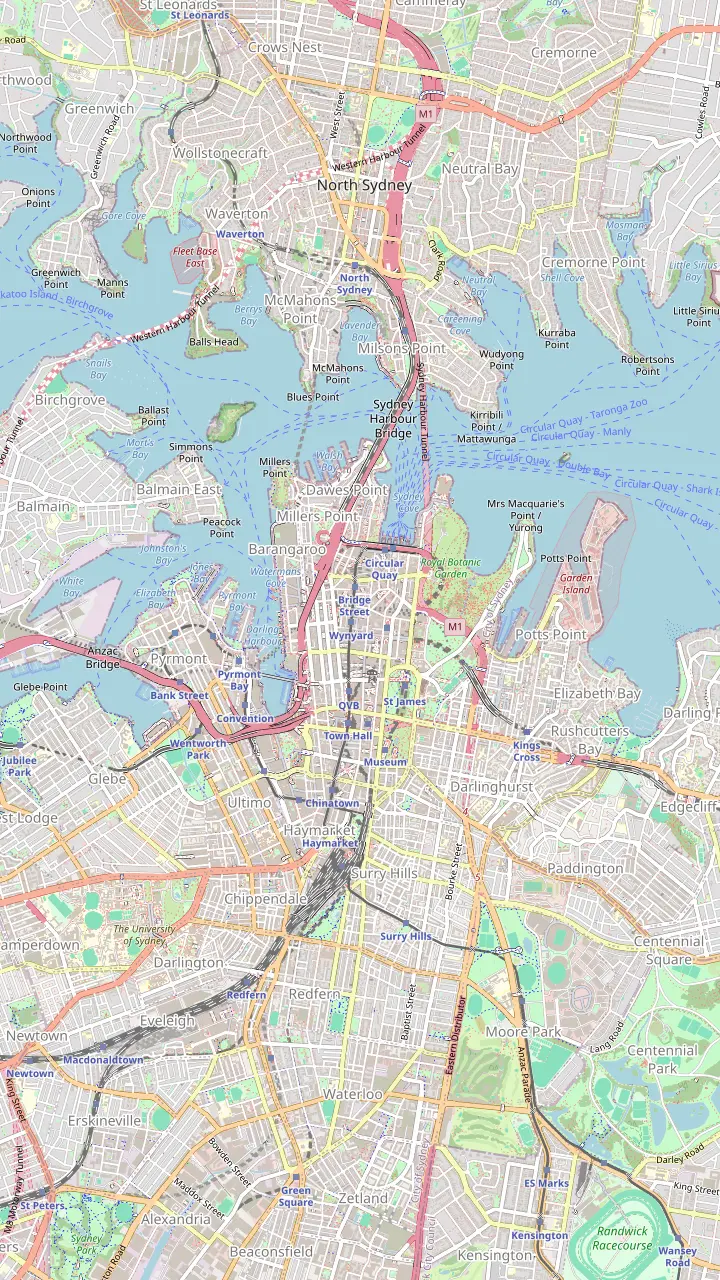
Route map
Tap a loop to see its stops in riding order, then a pin for the times and what is next to it.
Open 30 stops
Select a route, then press a pin or stop to read its note and open Google Maps.
Stop 1 is the change point outside the Justice and Police Museum: the first red bus leaves at 09:00 and the first blue bus at 09:30.
Google MapsStop 2, on Macquarie Street by the underpass, is the one for the Opera House and the harbour foreshore.
Google MapsStop 3 sits beside the Hyde Park Barracks; the cathedral plans major upgrade works from March 2027.
Google MapsStop 4 is outside the Art Gallery of New South Wales, where general entry costs nothing.
Google MapsStop 5, on Macleay Street in Potts Point, faces the El Alamein Fountain.
Google MapsStop 6 is on Cowper Wharf Road outside the Woolloomooloo Hotel, by the old finger wharf.
Google MapsStop 7 is where the red and blue loops meet on William Street; the museum is free and opens 10am to 5pm.
Google MapsStop 8 is on Eddy Avenue, at the exit outside Central Railway Station.
Google MapsStop 9 is outside the new fish market on Bridge Road, open daily from 7am to 10pm.
Google MapsStop 10, on Darling Drive by the convention centre, serves Darling Harbour and the Maritime Museum.
Google MapsStop 11 is on Harbour Street outside the Chinese Garden.
Google MapsStop 12 is on King Street beside SEA LIFE Sydney Aquarium.
Google MapsStop 13 is at the Barangaroo Station bus stop; the reserve nearby holds 75,000 native plants.
Google MapsStop 14 is on Hickson Road under the bridge, next to the Pier One hotel.
Google MapsStop 15, outside Campbell's Stores, is the last on the red loop; its last bus comes at 18:22.
Google Maps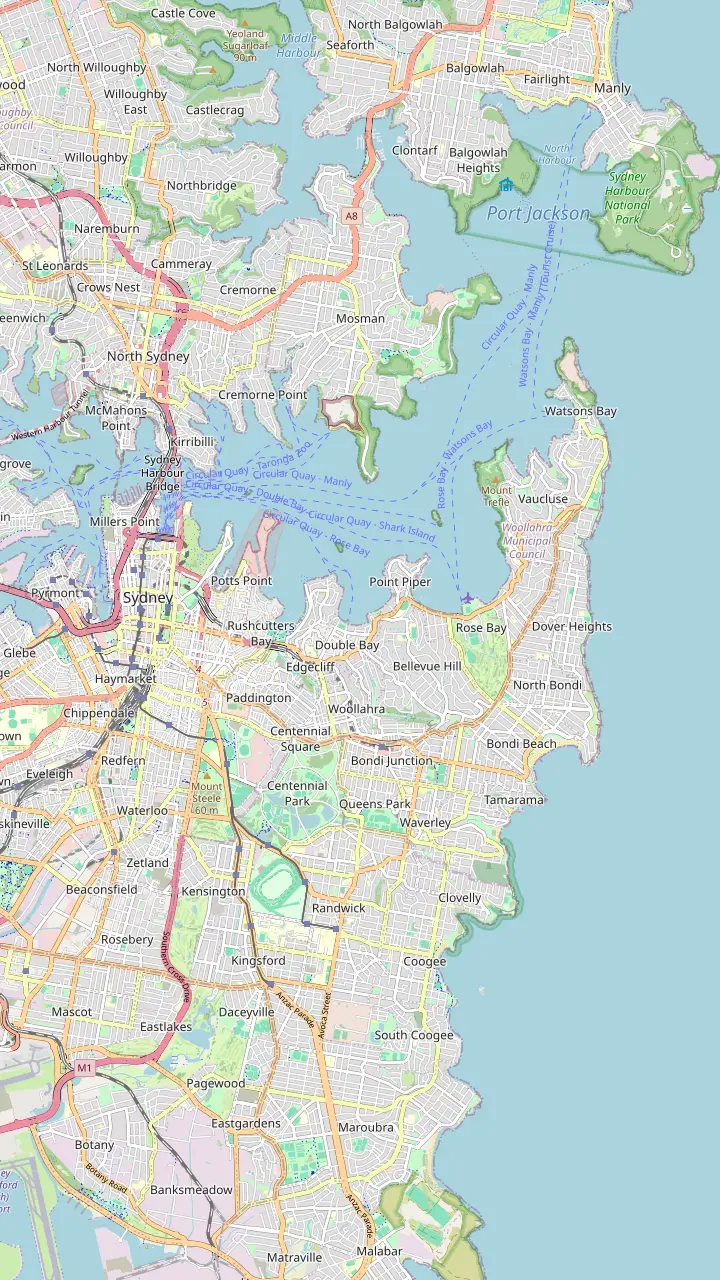
Stop 1 is the change point outside the Justice and Police Museum: the first red bus leaves at 09:00 and the first blue bus at 09:30.
Google MapsStop 16 is on York Street by the Queen Victoria Building; first bus 09:40.
Google MapsStop 17 is at the Oxford Street corner with Glenmore Road; Paddington Markets has traded since 1973.
Google MapsStop 18 is on Oxford Street opposite St Matthias Church, at the edge of the parklands.
Google MapsStop 19 is on Campbell Parade; the first bus arrives at 10:13 and the last at 17:30.
Google MapsStop 20 is at 294 Campbell Parade; the last bus calls at 17:38.
Google MapsStop 21 is at 401 New South Head Road, outside the Royal Arcade.
Google MapsStop 22 is the change point back to the red loop, outside the museum on William Street.
Google MapsStop 23 is at 179 Elizabeth Street, across from Hyde Park by St James Station.
Google Maps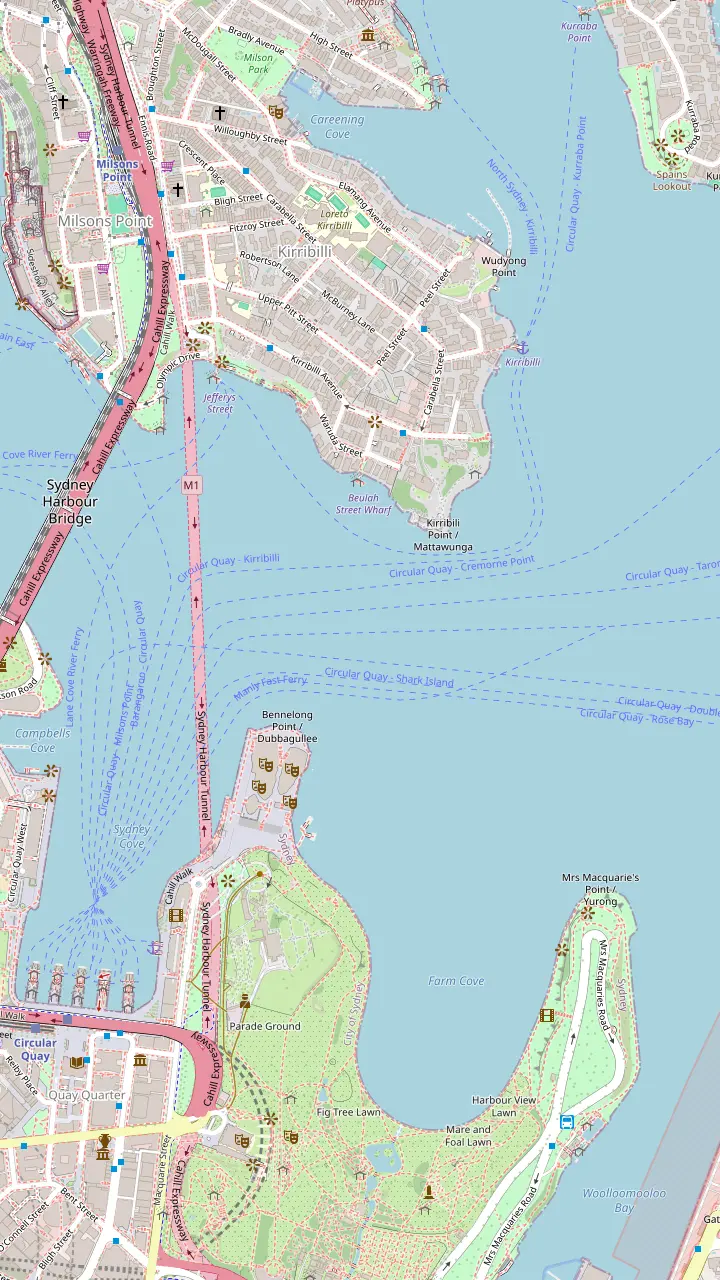
Stop 1 is the change point outside the Justice and Police Museum: the first red bus leaves at 09:00 and the first blue bus at 09:30.
Google MapsThe night tour's first 10-minute photo stop, next to the chair convicts carved from the rock in 1810.
Google MapsThe night tour's second 10-minute photo stop, on the north shore after the drive over the bridge.
Google Maps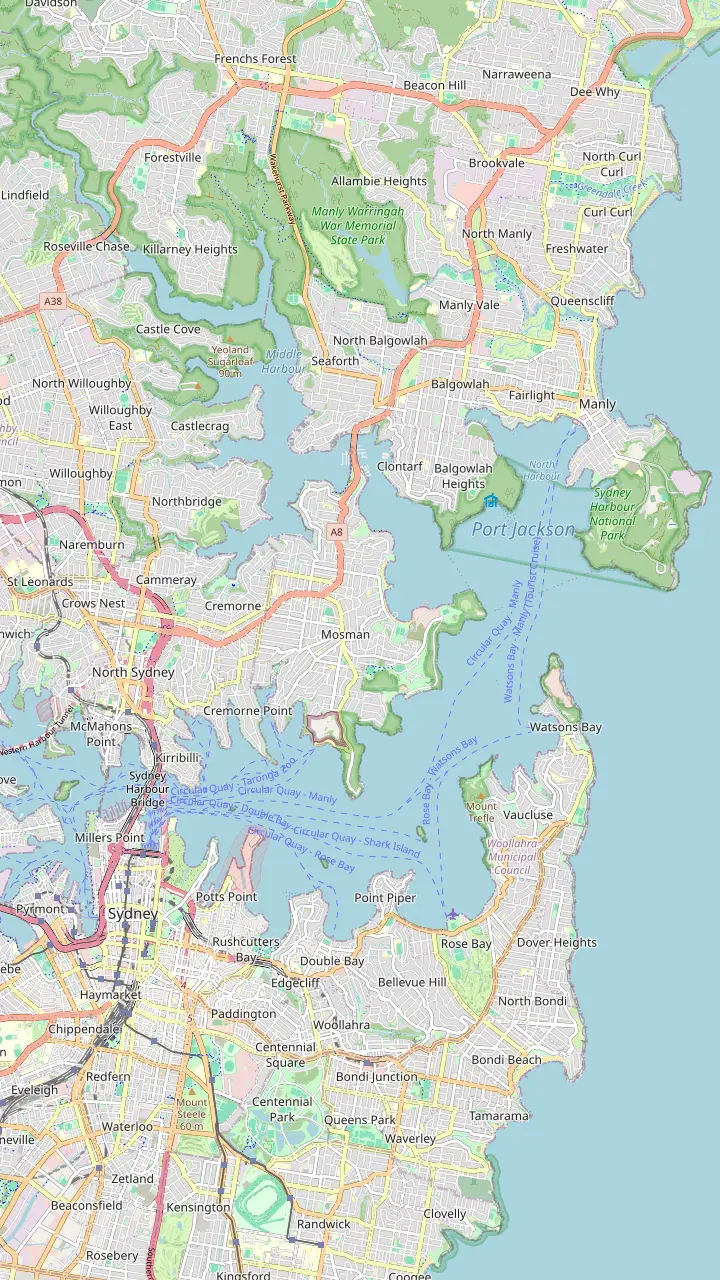
The harbour cruise sold with the bus ticket leaves from Circular Quay Wharf 6.
Google MapsA cruise stop; the record notes the zoo opens daily from 9.30 AM to 4.3 PM.
Google MapsA cruise stop on the small island Destination NSW lists as a picnic spot.
Google MapsA cruise stop; by public ferry from Circular Quay it takes less than 20 minutes.
Google MapsA cruise stop; the public ferry from Circular Quay takes 30 minutes.
Google MapsBase map © OpenStreetMap contributors
A capped day out
Morning
The L2 and L3 lines both start at Circular Quay.8
Late morning
A 12-minute crossing from Circular Quay.9
Afternoon
Evening
Trains run east as far as Bondi Junction.12
End of day
On a weekday the adult total stops at AUD 19.30.3
Picture a weekday of sights by public transport. A ferry from Circular Quay to Taronga Zoo takes 12 minutes, a ferry to Watsons Bay less than 20, and each adult ferry trip up to 9 km costs AUD 7.35.9,10,5 Add a light rail hop through the city and a train out to Bondi Junction, and you reach the AUD 19.30 weekday cap quickly; after that, every ride that day is free.3,12
On a Friday, Saturday or Sunday the same day is capped at AUD 9.65.3 The state tourism site points out that a capped weekend day takes you from Circular Quay to Manly, Taronga, Watsons Bay, Cockatoo Island or up the Parramatta River, all for less than a paid harbour cruise costs.66 On cost alone, public transport wins every time.
The bus day costs more, from $53, and gives something different. Its city route runs about 1 hr 30 min past the sights and its Bondi tour about 1 hr 15 min, with commentary throughout. There is no planning, no transfers and no tapping, and the route itself is designed as a tour. That is worth paying for on a first day; it is rarely worth paying for every day.
Video
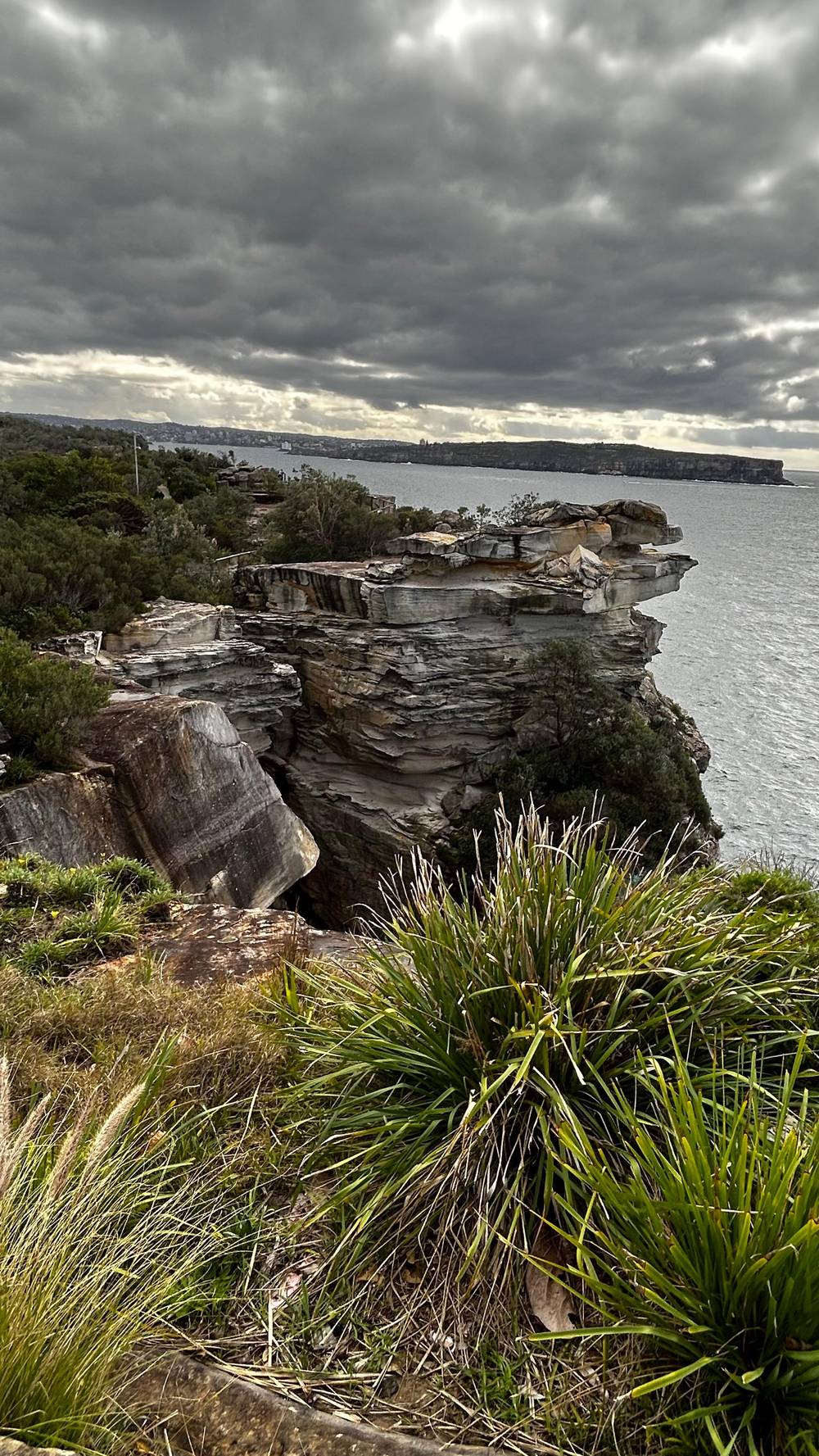
Josh Goes Slow on YouTube · Tap play to load the video; not before.
Using an Opal card or Contactless card is always cheaper than buying an Opal single ticket
Tap smart
The bus wins on your first day, when you do not yet know the city, and on any day you want explanations. Travelers who find stairs and platforms hard also do better on it: the listing calls it wheelchair accessible, and a single seat carries you from sight to sight. Families with small children gain too: infants aged 3 and under ride free.
Public transport wins on cost, on reach and in the evening. It goes to the airport, across the harbour by ferry, and out to suburbs the bus never visits, and it runs through the night on NightRide buses.12,11,15 It also wins on luggage days, because the sightseeing bus allows no suitcases or carry-on bags. And it wins on long stays, when the weekly cap of AUD 50 for an adult turns a week of harbour ferries, trains and light rail into a fixed and modest cost.3
Driving is the weakest option for sightseeing. A hired car spends most of a sightseeing day parked, and in the city that meter runs from AUD 2.50 up to AUD 8 each hour, depending on the street and the time.67 Taxis, water taxis and rideshare services such as Uber and Didi fill the gaps for a late return or a heavy bag.68 For most visitors the winning mix is the bus for a day, then taps for the rest.
Kids pay child fares between ages 4 and 15, and travel free up to the age of three.59 To pay child fares you need a Child/Youth Opal card, as a bank card tap is charged the adult fare.69,7 Child caps are AUD 9.65 a day from Monday to Thursday, AUD 4.80 from Friday to Sunday, and AUD 25 a week.70 Adult fares start at age 16.71
Seniors need an entitlement. The Gold Senior/Pensioner cap is AUD 2.50 a day, but interstate seniors must apply for a Gold Opal card to get discounted fares, and visitors without an Australian entitlement pay the adult fare.70,72 On the sightseeing bus, check the booking box for the age bands on your date.
For travelers with a disability, the Companion Card means the person helping them rides without paying.60 Because the sightseeing bus is marked accessible on its listing, it makes a gentle first look at the city before you tackle the stations and wharves. Seeing the layout from a seat first makes the trip planner far easier to use on the days that follow, as the stop names start to mean something.
FAQ
That is up to 3 km for an adult; off-peak it is AUD 2.31, and longer trips cost more.4
That weekday ceiling falls to AUD 9.65 for adults from Friday to Sunday and on holidays.3
Opal single tickets are a backup for metro, train, ferry and light rail; on buses, tap a card or phone.23
The bus starts from $53; Opal caps adults at AUD 19.30 a day Monday to Thursday.3
They replace most train routes between midnight and 4.30am, so a late dinner is no problem.15
Sources
Planning a day on the bus? Ask a real person here.